
Two articles can describe the same event accurately and still leave readers with different impressions. One may lead with what happened, another may examine why it happened, and a third may argue that officials should respond in a particular way. These differences often reflect journalistic format rather than a disagreement about the basic facts. However, format alone does not rule out weak reporting, selective evidence, errors, or bias. Readers still need to examine the sourcing and reasoning in each article. The first step is to identify whether the piece is a news report, an analysis, a signed opinion column, or an editorial representing the publication’s position.
Quick Overview: Why Is the Same Event Described Differently?
The clearest differences come from the purpose of the article and the type of judgment the writer is permitted to make.
1. Core Difference in Writing Purpose
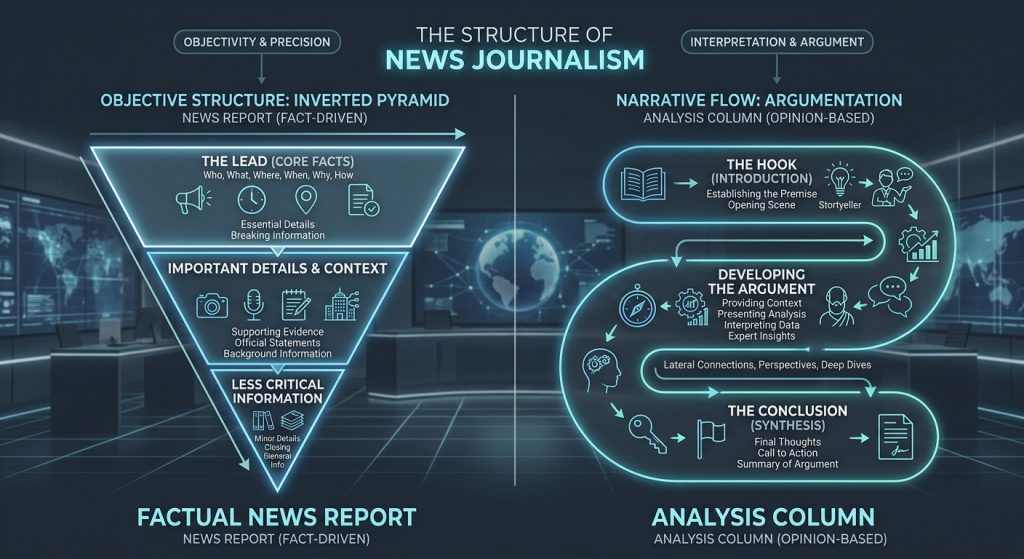
News Report: A news report establishes what happened, what is known, how the information was obtained, and what remains uncertain. It may also provide background and limited interpretation needed to understand the event.
Analysis Column: Analysis explains relationships among verified facts. It may examine causes, consequences, historical context, policy constraints, or possible future outcomes. Analysis does not automatically mean personal opinion, although some publications combine analysis and commentary under similar labels.
Editorial: An editorial expresses a position adopted by an editorial board or publication. It may support a policy, criticize a decision, recommend action, or state the outlet’s judgment on a public issue. At the Los Angeles Times, for example, the editorial board describes itself as the institutional voice of the newspaper and operates separately from the newsroom.
A signed opinion column is different from an editorial. It generally represents the named writer’s view rather than the official view of the publication.
2. The Author’s Starting Point
News Reporter: A reporter usually starts with a question, event, document, observation, or new claim. The reporter gathers evidence, interviews relevant people, tests competing accounts, and determines what can be responsibly published.
This process is not completely without selection. Reporters and editors still decide which facts deserve emphasis, which sources are credible, and which background information the audience needs.
Analyst or Columnist: An analyst generally starts with an established body of facts and asks what those facts mean. A columnist may start with a thesis or judgment and build an argument around it.
That does not give a columnist permission to select only convenient evidence. Reliable opinion writing should acknowledge important contrary facts and separate verifiable claims from predictions, values, and personal conclusions.
News Reports The “Just the Facts” Mission
“Just the facts” is a useful shorthand, but it does not fully describe modern news reporting. Readers often need context to understand why an event matters, who is affected, and which earlier developments led to it.
The American Press Institute found that 63% of surveyed Americans preferred reporting that supplied mostly facts together with some background and analysis. Only a small portion said they wanted facts with no context at all.
Core Structural Attributes of a News Report
Neutral, Distance-Preserving Language: Reporters should avoid presenting their own political or personal views as conclusions. Reuters distinguishes its fact-based news file from clearly labeled opinion and prohibits its news journalists from inserting their own opinions into news stories.
There is no universal prohibition on first- or second-person pronouns. First person may appear in an eyewitness account, methodology note, reported essay, or article explaining how an investigation was conducted. Second person may appear in consumer guidance. What matters is whether the language accurately represents the article’s format.
Named and Verified Attribution: Claims, allegations, estimates, quotations, and disputed interpretations should be attributed so readers know who is responsible for them.
Not every sentence requires a named source. A reporter may directly state information established through public records, firsthand observation, independently verified data, or widely documented events. The article should still make the evidence trail clear enough for the reader to understand how significant claims were verified.
Anonymous sources require additional caution. Their information should be assessed according to their access, motive, corroboration, and the reason anonymity was granted.
Multi-Perspective Balance: Fair reporting should include relevant perspectives, especially when a person or organization faces a serious allegation. Reuters instructs journalists not to present allegations as facts and to give the subject a fair opportunity to respond.
Fairness does not require equal space for every claim. A position contradicted by strong evidence does not have to receive the same weight as a well-supported conclusion. The goal is proportional treatment based on relevance and evidence, not mechanical equality.
Analysis Columns Giving Voice to Personal Perspective
The label “analysis column” can create confusion because “analysis” and “column” do not always mean the same thing.
A news analysis usually remains part of the reporting operation. It explains the meaning of verified developments without necessarily advocating a personal position. A signed column gives the writer greater freedom to make judgments and argue for a conclusion.
Readers should inspect the section label, byline, author description, and any disclaimer rather than relying only on the article’s tone.
Core Structural Attributes of an Analysis Column
Personal and Conversational Tone: A columnist may use “I” or address the reader directly, but this is optional. Some columns use a formal, evidence-heavy style without first person. Conversely, an explanatory news article may sound conversational without becoming opinion.
Focused Argumentation: Analysis often selects one important dimension of an event. An economic analysis may examine market effects, while a legal analysis may focus on statutory authority or court precedent.
This narrower focus explains why analysis pieces can reach different conclusions without necessarily contradicting each other. They may be answering different questions.
Grounded in Verified Fact: Interpretive journalism must distinguish evidence from inference. Reuters permits named authors in clearly separated columns to express points of view but requires those views to be grounded in the writer’s field of expertise rather than unsupported assertion or personal attack.
Predictions should be identified as predictions. Estimates should include their assumptions. A responsible analyst should also discuss the strongest evidence that could weaken the argument.
The “Confusion Trap” for Modern Readers: Insights from Large-Scale Surveys
Digital distribution can separate an article from the section in which it originally appeared. A social-media post may show the headline and image without displaying the “Opinion,” “Analysis,” or “Editorial” label clearly.
[Social Media Access] ➔ [Reduced Section and Label Context] ➔ [Higher Risk of Mistaking Interpretation for Straight Reporting]
This does not prove that readers’ media literacy has declined continuously over time. The studies cited below are snapshots of particular groups and questions, primarily from the United States in 2018.
Landmark Survey Findings from Pew Research Center
Pew Research Center surveyed 5,035 U.S. adults and asked them to classify five factual statements and five opinion statements.
Twenty-six percent correctly identified all five factual statements, while 35% correctly identified all five opinion statements. Those figures in the original article were accurate.
The broader results provide essential context:
- 72% correctly classified at least three of the five factual statements.
- 78% correctly classified at least three of the five opinion statements.
- Each individual statement was classified correctly by a majority of respondents.
Pew was testing whether statements were capable of being proved or disproved, not whether participants knew which statements were true. A factual statement can be inaccurate and still be factual in form because objective evidence could test it.
The study therefore identified meaningful difficulty, but it did not show that most readers routinely confuse subjective commentary with reality.
Industry Alerts from Professional Journalists
The claimed SPJ survey involving 361 journalists and 367 members of the public could not be verified and should not be used.
The Society of Professional Journalists instead provides an ethical principle directly relevant to the problem: advocacy and commentary should be labeled, and journalists should not distort facts or context.
A separate 2018 Media Insight Project study surveyed 2,019 U.S. adults and 1,127 journalists. It found that 42% of public respondents believed most news reporting they encountered looked like opinion and commentary posing as news. Another 17% believed news contained too much analysis.
That result measures audience perception. It does not establish that 42% of news reports actually were disguised opinion.
The same research found that half of respondents were unsure what an op-ed was, while fewer than half confidently understood the difference between an editorial and a news story. It recommended clearer labeling, greater transparency about sources, and more explanation of reporting decisions.
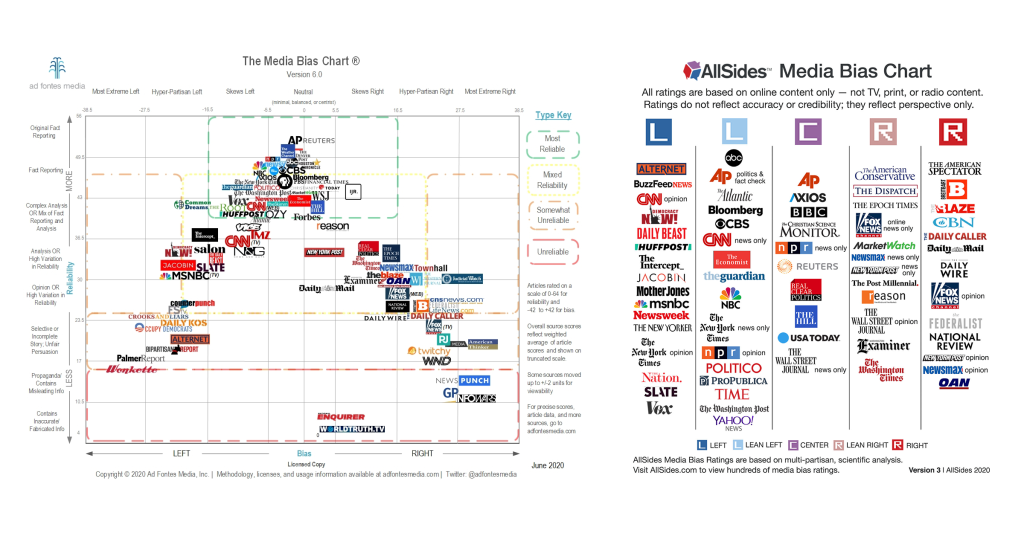
5 Critical Filters for Smart Readers (Actionable Checklist)
- Trace Claim Origins: Identify whether important claims come from direct observation, documents, data, named sources, anonymous sources, or the writer’s interpretation. A large number of links does not guarantee that the sources support the conclusion.
- Measure the Evidence-to-Conclusion Gap: Separate what the evidence proves from what the author predicts or recommends. Words such as “may,” “likely,” and “could” indicate uncertainty and should not be rewritten mentally as certainty.
- Guard Against Emotional Trigger Words: Emotional language can reveal framing, but strong language is not automatically misleading. Ask whether the wording accurately describes the evidence or substitutes emotion for evidence.
- Verify Headline Accuracy: Compare the headline with the body. Determine whether it states a confirmed development, summarizes an interpretation, asks a question, or presents an editorial judgment. Also check whether important qualifications appear only deep in the article.
- Uncover Hidden Context Pieces: Look for omitted dates, comparison baselines, legal limits, conflicting evidence, and responses from the people criticized. In opinion writing, ask whether the author addresses the strongest reasonable counterargument rather than an artificially weak version of it.
News reports, analysis columns, and editorials can describe the same event differently because they perform different jobs. A news report establishes and verifies developments. Analysis connects those developments to context and consequences. A signed column argues from the writer’s perspective, while an editorial generally states the position of the publication or editorial board. Readers should not assume that news is free of framing or that opinion is free of factual obligations. The reliable approach is to identify the genre, trace the evidence, separate reporting from inference, and judge whether the conclusion is proportional to the facts presented.